US — The United States has introduced a major overhaul to its H-1B visa selection process for the 2026–2027 cycle, replacing the long-standing random lottery with a wage-weighted system that favors higher-paid positions. The policy shift, implemented by the U.S. Citizenship and Immigration Services (USCIS), aims to prioritize highly skilled workers and address concerns about wage suppression in the American labor market.
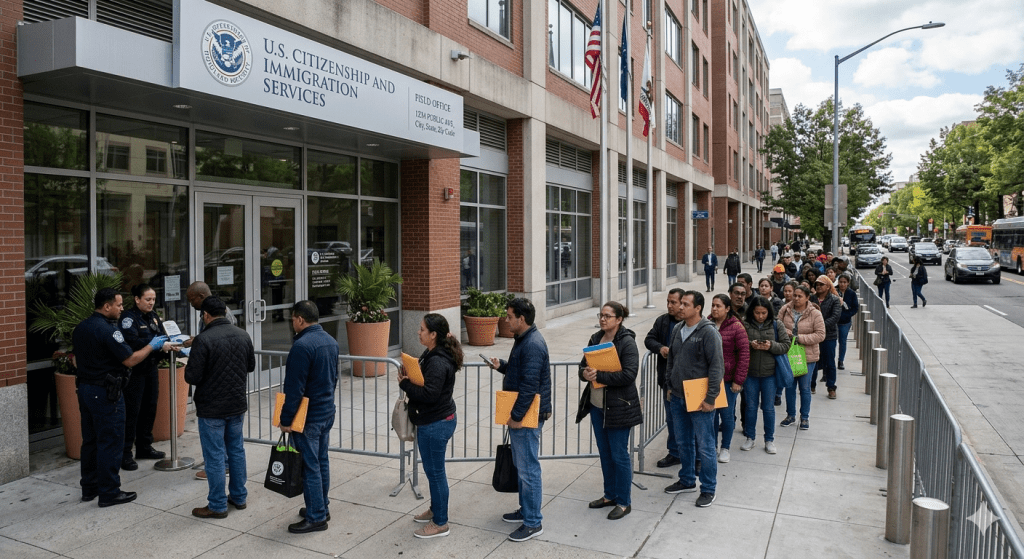
Lottery Completed for FY 2027
USCIS announced on March 31, 2026, that it had received enough electronic registrations to meet the annual H-1B cap for Fiscal Year (FY) 2027. With the selection process now complete, employers whose beneficiaries were chosen can begin submitting full H-1B petitions.
The filing window opened on April 1, 2026, and will remain open until June 30, 2026. During this 90-day period, employers must submit complete petitions along with supporting documentation.
New Form Requirement
From April 1, 2026, USCIS has made it mandatory for employers to submit the updated 02/27/26 edition of Form I-129, which is used for nonimmigrant worker petitions. Older versions of the form will be automatically rejected.
In another change affecting applicants and employers, the premium processing fee—used to expedite petition review—was increased to $2,965, effective March 1, 2026.
Wage-Weighted Selection System Introduced
For the first time in the program’s history, the H-1B selection process is no longer purely random. Instead, it uses a weighted system based on wage levels determined by the U.S. Department of Labor.
Under the new structure:
- Level IV wages: 4 entries in the selection pool
- Level III wages: 3 entries
- Level II wages: 2 entries
- Level I wages: 1 entry
This approach increases the probability that higher-paying jobs will receive H-1B visas, aligning the program more closely with high-skill, high-salary roles.
$100,000 Supplemental Fee Introduced
Another significant change stems from a presidential proclamation issued in September 2025. The new rule requires a $100,000 supplemental fee for H-1B petitions filed on behalf of beneficiaries residing outside the United States.
However, applicants already present in the U.S.—such as international students transitioning from F-1 status—are generally exempt if they are filing a change-of-status petition.
Beneficiary-Centric Selection Continues
The FY 2027 process also continues the beneficiary-centric selection model introduced in recent years. Instead of counting each employer registration separately, USCIS identifies unique applicants through passport numbers.
This ensures that each individual receives only one chance in the selection process, even if multiple employers submit registrations on their behalf.
Government’s Rationale
The changes are part of broader efforts by the U.S. government to reform the H-1B program and ensure it benefits both American workers and high-skilled foreign professionals.
According to Joseph B. Edlow, director of USCIS, the reforms aim to prevent misuse of the visa system.
“The H-1B nonimmigrant visa program was created to bring temporary workers into the United States to perform additive, high-skilled functions, but it has been deliberately exploited to replace, rather than supplement, American workers with lower-paid, lower-skilled labour,” Edlow said.
He added that some information technology firms have “prominently manipulated” the process by submitting multiple registrations for the same worker to increase selection chances, practices the new system intends to eliminate.
Impact on Applicants and Employers
The shift to wage-weighted selection is expected to significantly reshape the H-1B landscape, potentially benefiting companies offering higher salaries while making it more difficult for lower-wage roles to secure visas.
For employers and foreign professionals alike, the FY 2027 cycle marks one of the most consequential changes in the history of the H-1B visa program.