New Delhi — In a significant move aimed at safeguarding the integrity of national examinations, the Government of India has temporarily blocked access to the Telegram messaging platform across the country until June 22, 2026. The emergency restriction has been imposed to curb examination-related fraud and prevent the spread of misinformation surrounding the upcoming NEET (UG) 2026 re-examination.
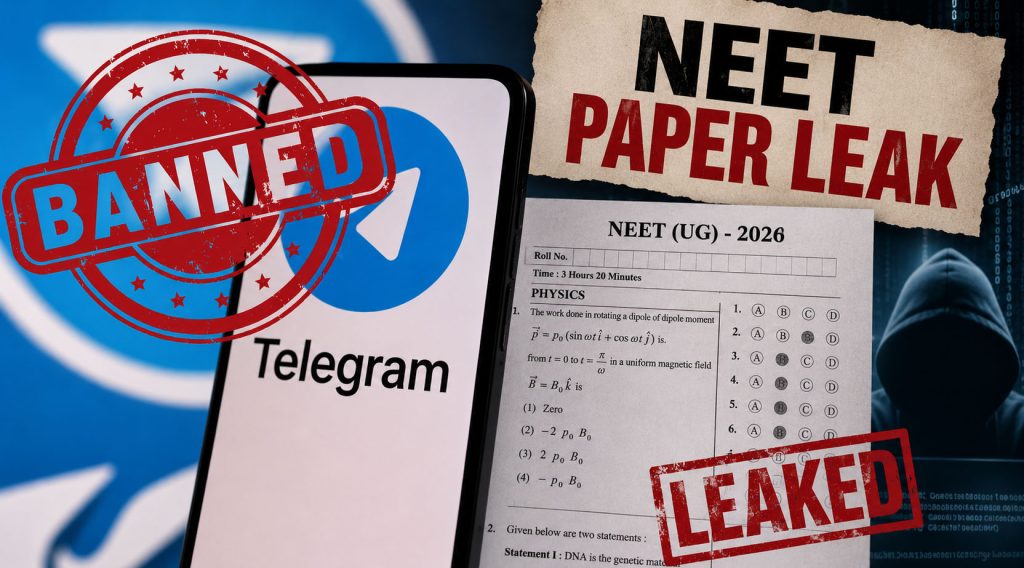
Telegram Access Suspended Until June 22
According to official sources, the nationwide block came into effect immediately and will remain in force until June 22, covering the period before, during, and shortly after the NEET re-examination scheduled for June 21, 2026.
In addition to the temporary shutdown, Telegram’s message-editing feature has been disabled across India until June 30, 2026, preventing users from modifying previously published content.
The order was issued by the Ministry of Electronics and Information Technology (MeitY) under Section 69A of the Information Technology Act, 2000, following recommendations from examination and security authorities.
Authorities Target Exam Cheating Networks
Government agencies identified several Telegram channels allegedly operating under names such as “Paper Leaked NEET” and “Private Mafia”, which were reportedly offering examination papers to students in exchange for payments ranging from thousands to lakhs of rupees.
Investigators found that many of these channels were exploiting Telegram’s message-editing feature to create false evidence of paper leaks. In several cases, scammers allegedly uploaded genuine examination questions after exams had concluded and then edited older posts to make it appear that the papers had been leaked in advance.
Officials believe these practices have contributed to widespread confusion, panic among students, and public distrust in examination processes.
Wider Investigation Underway
The temporary ban is also linked to a broader investigation being conducted by the Ministry of Home Affairs (MHA) regarding Telegram’s compliance with Indian regulations and concerns over the platform’s alleged use in extortion, gambling operations, and previous information leak cases.
Authorities stated that the current action is a preventive measure designed to protect examination integrity while investigations continue.
NTA Clarifies: No NEET Paper Leak Has Occurred
Welcoming the government’s intervention, National Testing Agency (NTA) spokesperson Abhishek Singh emphasized that there has been no confirmed leak of the upcoming NEET-UG re-examination paper.
“The NTA categorically clarifies that no examination paper has been leaked. Any claims, offers, or advertisements circulating online regarding advance access to question papers are fraudulent and intended to deceive students,” the spokesperson said.
Joint Crackdown on Fraudulent Groups
The NTA confirmed that it is working closely with the Indian Cyber Crime Coordination Centre (I4C) and various state police departments to identify and remove thousands of suspicious groups, channels, and automated bots involved in spreading fake leak claims and extortion attempts.
Cybercrime teams have reportedly intensified monitoring efforts ahead of the examination to ensure a fair and secure testing environment.
Advisory for Students
The NTA has urged NEET aspirants to ignore social media rumors and focus on their preparation rather than falling victim to online scams.
Students have been advised to immediately report any suspicious messages, demands for money, or claims of paper leaks through the National Cyber Crime Helpline (1930) or the official cybercrime reporting portal. Officials reiterated that strict action will be taken against individuals and organizations attempting to exploit students through fraudulent schemes.
The temporary Telegram restriction represents one of the strongest measures taken by Indian authorities to combat examination-related fraud. With millions of students preparing for crucial competitive examinations, the government maintains that protecting the credibility of the testing process remains a top priority.
As the NEET-UG 2026 re-examination approaches, authorities continue to emphasize that students should rely only on official information sources and remain vigilant against online scams and misinformation.