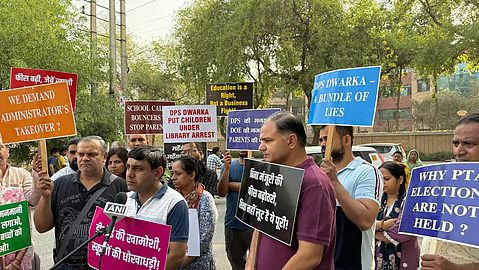
NEW, DELHI — Tensions escalated in the national capital on Monday as hundreds of parents staged a protest outside the Directorate of Education (DoE), demanding action against private schools accused of imposing steep and “arbitrary” fee hikes. The demonstration follows a recent legal development in which the Delhi High Court paused the implementation of the Delhi School Education (Transparency in Fixation and Regulation of Fees) Act, 2025, allowing schools to continue charging the same fee structure as the previous academic year for now.
Court Puts Temporary Hold on Fee Regulation
The controversy intensified after the Delhi High Court stayed a government notification that required private schools to obtain prior approval from the Directorate of Education before increasing tuition fees. The court’s order effectively maintains the status quo, permitting schools to collect fees at the same level as the 2025–26 academic session until the legal challenge against the 2025 Act is resolved.
A final hearing on the matter had been scheduled for March 12, 2026, but the broader issue of fee regulation continues to spark heated debate between parents, school authorities, and the government.
Parents Accuse Schools of Arbitrary Hikes
Protesting parents alleged that several private institutions — particularly those operating on government-allotted Delhi Development Authority (DDA) land — have increased fees by 20% to 60% without mandatory approval from the Directorate of Education.
Some parents displayed fee receipts during the protest, claiming that charges for classes such as Senior KG had surged to ₹2.25 lakh annually. Demonstrators described the hikes as “daylight loot” and demanded a full audit of school finances.
“This is not education — it is extortion,” one protesting parent said, accusing schools of exploiting families already struggling with rising living costs.
Allegations of Student Harassment
Parents also raised serious concerns about alleged harassment of students whose families refused to pay the increased fees. Some claimed that schools had confined children to libraries or prevented them from attending classes by deploying security guards at school entrances.
One parent said such actions were “humiliating for students and psychologically harmful,” urging authorities to intervene immediately.
Schools Defend Fee Increases
School managements, however, have defended the fee revisions. Administrators argue that rising operational costs, including teacher salaries, infrastructure maintenance, and inflation, have made fee adjustments unavoidable.
They also maintain that regulatory interference could undermine the financial sustainability of private educational institutions.
Parent Associations Question Oversight Mechanisms
Parent associations have criticized the current regulatory framework, particularly School Level Fee Regulation Committees (SLFRCs), arguing that these bodies are often influenced by school management and therefore fail to provide meaningful oversight.
Activists claim that without stricter monitoring, parents will continue to face unjustified financial pressure.
Government Response
The Directorate of Education has reiterated that schools built on government land must obtain prior approval before implementing any fee increase. Officials warned that institutions violating the rules could face strict action, including revocation of recognition.
The standoff between parents, schools, and authorities highlights the ongoing struggle to balance affordable education for families with the financial requirements of private schools. As the legal battle over the Delhi School Education (Transparency in Fixation and Regulation of Fees) Act, 2025 continues, the issue is expected to remain a major policy debate in the coming months.